Work
A few things I've built and what came of them. The methods behind them are on the Methods page.
Ex-ante carbon forecasting and the inoculation recommender
The problem. Funga sells carbon credits before the trees have grown. That means forecasting how much extra carbon a mycorrhizal inoculation will produce on a given site, decades out, with uncertainty a buyer will accept and an auditor will sign.
What I did. Built the ex-ante forecasting system and designed the recommender that turns R&D results and operational constraints into a decision about which fungal community goes on which acre. Built v2 myself and now lead the team on subsequent versions. Oversee the R&D analytics and experimental design behind it, across nursery experiments and 60+ field trials. Led the port of the legacy R models to production Python pipelines with simulation-based validation, reproducibility, and CI review, raising predictive R² from 0.24 to 0.47. This is the company’s core revenue product, running across 60,000+ project acres in the southeastern US.
What happened. $24.3M+ in ex-ante credit sales to buyers including Netflix and Swire, and $8M in follow-on financing. I was the sole technical owner of the third-party diligence (Xilva) behind the $6.3M+ Swire offtake agreement.
A new Verra carbon methodology (M0274)
The problem. No existing methodology could credit microbiome-driven forest growth. Without one, the credits don’t exist. I took over a first draft midway through the process and found the quantitative framework needed to be rebuilt.
What I did. Took ownership of the methodology and reworked the entire analytical framework: the paired control-plot crediting math, the additionality test, and the uncertainty provisions. Led the statistical response through public comment and validation/verification body review.
What happened. Release planned for January 2027. I’m now designing a second crediting program under VM0045 for elite forest genetics: a matched-baseline design for treatment at planting and a power-analysis simulation of the control-plot layout, delivered to the executive team as decision memos.
Building the data science function
Set data science strategy and roadmap priorities with Product, Growth, Engineering, and Operations leadership. Established model governance and engineering standards for the team: simulation-based validation, reproducibility, CI code review, MLflow. I scope, review, and mentor the modeling work of six data scientists and data engineers, and I’m the hiring manager for DS roles.
AI-assisted analysis without loosening the rigor
The problem. AI coding agents can speed up analysis enormously, and can just as quickly produce confident, unreproducible nonsense. The team needed the speed without lowering the bar.
What I did. Built a spec-driven workflow for AI-assisted analysis with Claude Code and ChatGPT: a written analysis spec and change log for every piece of work, one issue, branch, and PR per change, CI checks, and my statistical review on every merge. Agent-written code is held to exactly the same reproducibility standard as hand-written code.
What happened. Used it to deliver the 2026 carbon-cohort R&D analysis and board reporting. The workflow is now standard for the team.
Forecasting a fatal disease in a deer population
The problem. Chronic wasting disease is a fatal prion disease spreading through white-tailed deer. Wildlife managers needed forecasts of population impacts under different interventions, from data that was messy, spatial, and mostly collected by hunters.
What I did. Built a spatiotemporal integrated population model fusing 10+ data streams: GPS collars, harvest surveillance, survival records, environmental covariates. Hierarchical Bayesian survival and force-of-infection models. Machine learning for behavioral state inference, including predicting births from movement data with semi-supervised anomaly detection.
What happened. Decision-support workflows that state managers used to compare management scenarios. A distributed computing rewrite that cut inference runtime 720×. Peer-reviewed papers in Journal of Applied Ecology, Methods in Ecology and Evolution, and Wildlife Monographs. I also supervised and mentored five PhD-level researchers and designed and taught a graduate seminar on machine learning in wildlife ecology.
Data infrastructure for an electric-utility analytics product
Designed and deployed the PostgreSQL backend and the automated Python ETL pipelines that downstream models and reporting ran on. High-volume, heterogeneous source data.
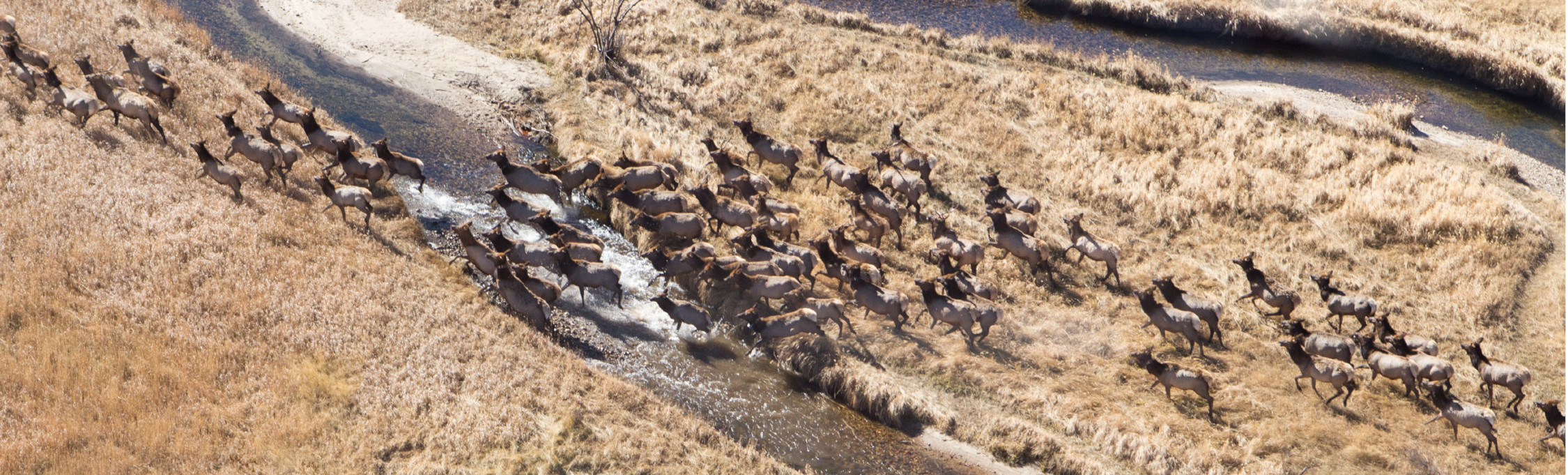
Elk in Rocky Mountain National Park
PhD work on the elk population in Rocky Mountain National Park: an N-mixture model that combined movement, survival, and aerial transect counts to estimate the abundance of an open population, and a Bayesian forecasting framework that showed managers what a year of monitoring was actually worth. Alongside that, statistical consulting for clients across disciplines at the Graybill Statistical Laboratory. The elk counts were done from a helicopter.